
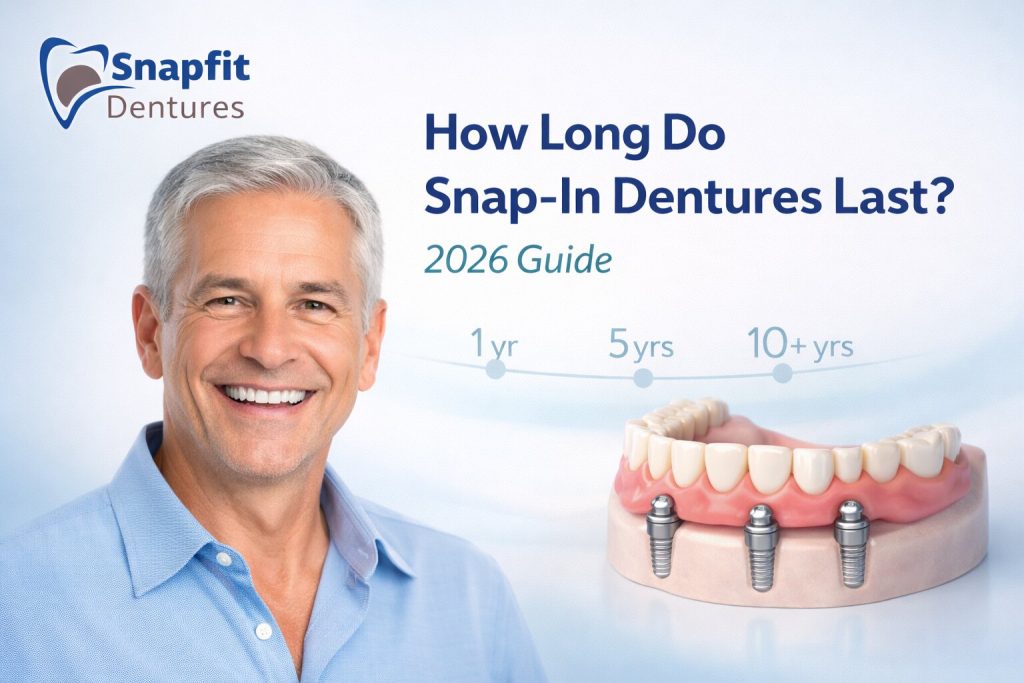
If you’re considering snap-in dentures, one of the most common questions is: how long do snap-in dentures last?
In most cases, the denture lasts 5–10 years, the implants can last 20+ years, and the attachment clips typically need replacing every 1–2 years. This gives a clearer, more realistic picture of long-term value for patients considering treatment in the UK.
The short answer is: they last a long time — but not all parts last equally.
Snap-in dentures are a multi-component system. The implants, denture, and attachment mechanisms all function together, but each has its own lifecycle. Understanding this distinction is what separates a superficial answer from a clinically accurate one.
The Real Lifespan of Snap-In Dentures
For patients researching snap-in dentures in Wolverhampton and across the West Midlands, understanding lifespan is key to making an informed decision.
Clinically, snap-in dentures (implant-retained overdentures) typically last:
- Denture (removable prosthetic): 5–10 years
- Dental implants: 20+ years (often lifelong)
- Attachments (clips/O-rings): 1–2 years
This is consistent across clinical literature and long-term outcome studies.
So when patients ask, “How long do snap-in dentures last?”, the correct answer is: it depends which component you’re referring to.
Breaking It Down: Each Component Explained
For a complete overview of how snap-in dentures work, see our full guide to snap-in dentures.
1. Dental Implants — The Foundation
Dental implants are the most durable part of the system.
They are designed to integrate with the jawbone through osseointegration, creating a stable, long-term anchor.
- Typical lifespan: 20+ years
- Long-term survival rates: 90–95%+
Once successfully integrated, implants can last decades with proper care. This is why snap-in dentures are considered a long-term solution rather than a temporary fix.
2. The Denture — The Replaceable Component
The denture is the visible, removable part of the system — and the part that naturally wears down over time.
- Typical lifespan: 5–10 years
- With excellent care: up to 10–15 years in some cases
The main reasons for wear include:
- Daily chewing forces
- Gradual jawbone changes
- Material fatigue
Even with implants stabilising the denture, the underlying bone continues to remodel slowly. Over time, this affects fit and function, making replacement or relining necessary.
3. Attachments — The Maintenance Layer
Attachments (such as locator inserts or O-rings) are designed to wear out.
- Typical lifespan: 1–2 years
This is intentional. These components act as a buffer between the denture and implants.
Replacing them regularly:
- Maintains a secure fit
- Reduces stress on implants
- Prevents long-term damage to the system
This is not a failure — it is routine maintenance.
Why Snap-In Dentures Don’t “All Last Forever”
A common misconception is that the entire system should last the same length of time.
In reality, snap-in dentures are designed as a modular system:
- Implants = long-term foundation
- Denture = replaceable structure
- Attachments = serviceable components
This design is deliberate.
Instead of full replacement every few years (as with traditional dentures), individual parts are maintained or replaced as needed. This improves long-term predictability and cost efficiency.
What Affects Their Lifespan?
Several clinical and behavioural factors influence longevity.
Oral Hygiene
Poor hygiene increases the risk of peri-implant complications.
Consistent daily cleaning significantly improves long-term outcomes.
Material Quality
Higher-grade materials (such as reinforced acrylic or zirconia frameworks) resist wear more effectively and extend denture lifespan.
Number of Implants
More implants distribute bite forces more evenly.
This reduces stress on both the denture and attachment system, improving durability.
Smoking and General Health
Smoking is strongly associated with lower implant success rates and increased complication risk.
Systemic health factors also play a role in long-term stability.
Maintenance and Reviews
Regular reviews allow for:
- Attachment replacement
- Fit adjustments
- Early detection of issues
Relines are typically required every 3–5 years to maintain optimal fit as the jawbone changes.
Snap-In Dentures vs Traditional Dentures (Lifespan Comparison)
Traditional dentures:
- 5–7 year average lifespan
- Faster bone resorption
- More frequent adjustments and instability over time
Snap-in dentures:
- Denture: 5–10 years
- Implants: decades
- Greater stability and long-term predictability
The advantage is not just lifespan — it is structural stability and reduced long-term deterioration.
How to Maximise Lifespan
For a deeper look at long-term value and decision-making, you can also read: Are Snap-In Dentures Worth It?
Patients who achieve the longest outcomes typically follow consistent maintenance habits.
This includes:
- Daily cleaning of both denture and implants
- Routine dental check-ups
- Timely replacement of attachment components
- Avoiding excessive bite forces (e.g. grinding or very hard foods)
The system performs best when treated as something maintained — not installed and ignored.
Are Snap-In Dentures a Long-Term Solution?
Yes — but with a specific definition.
Snap-in dentures are not a single static treatment.
They are a long-term system built on:
- A durable implant foundation
- A replaceable prosthetic
- Ongoing maintenance
This structure is precisely what makes them more reliable than traditional dentures over time.
The Bottom Line
If you’re considering treatment locally, speaking to a specialist denture practice in Wolverhampton can give you a personalised estimate based on your oral health, bone structure, and lifestyle.
Snap-in dentures are designed to last — but in layers.
- Implants can last decades
- Dentures typically last 5–10 years
- Attachments require periodic replacement
Understanding this structure gives a more accurate picture of long-term value.
Rather than repeatedly replacing an unstable solution, you maintain and upgrade a stable system.
That distinction is what defines snap-in dentures as a modern, long-term option.