
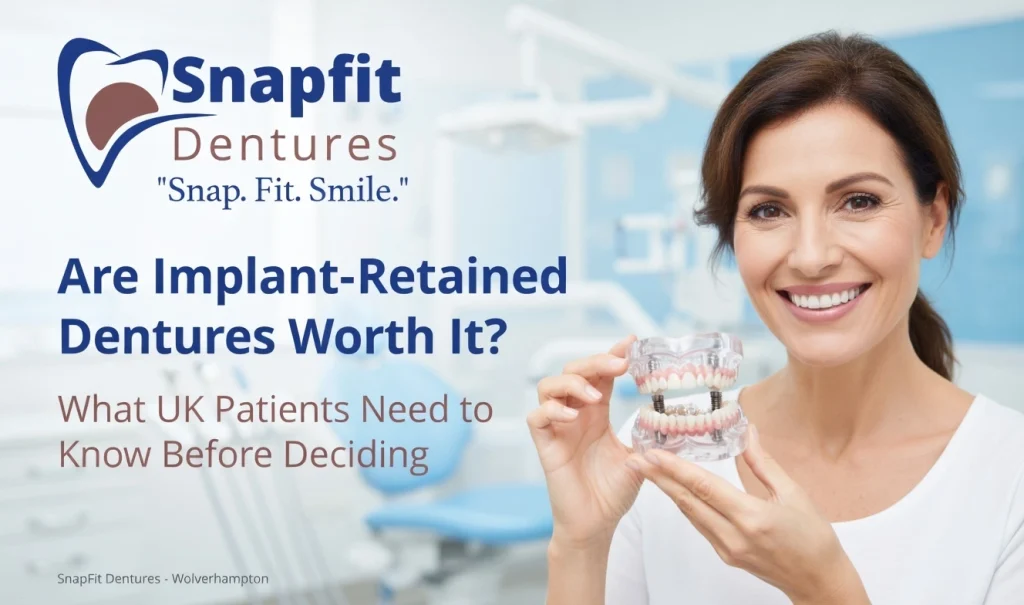
Are Implant-Retained Dentures Worth It? What UK Patients Need to Know Before Deciding
Replacing missing teeth or upgrading from uncomfortable dentures is a big decision — financially, emotionally, and physically. And with so many options available, it’s easy to feel overwhelmed before you’ve even had a conversation with a dentist.
This guide is for patients who are still in the research stage. Not ready to book yet. Just trying to understand whether implant-retained dentures are actually worth the investment — and whether they’d work for someone in your situation.
We’ll cover how they work at a biological level, who they realistically suit, what the long-term picture looks like, and the questions most patients wish they’d asked sooner. No sales pitch — just the information you need to make a confident, informed decision.
First: What Does “Implant-Retained” Actually Mean?
The term gets used a lot, but it’s worth understanding precisely what it means — because it changes everything about how these dentures perform.
A conventional denture sits on top of your gum tissue. It relies on the natural shape of your gum ridge and, often, adhesive paste to stay in place. Over time, as your jawbone naturally shrinks after tooth loss, that fit deteriorates.
An implant-retained denture works completely differently. Small titanium posts — dental implants — are surgically placed into your jawbone. These act as artificial tooth roots. Your denture then attaches directly onto these implants, either with a snap-fit mechanism (known as a locator system) or a bar attachment.
The result: a denture that is anchored to your bone, not just resting on your gum. It cannot shift, slip, or lift when you eat or speak.
The Biology Behind It: Why Titanium, and Why the Jawbone?
This is the part most patients find genuinely surprising.
Titanium is one of the very few materials the human body doesn’t reject. When a titanium implant is placed into the jawbone, the bone tissue actually grows around and fuses with it — a process called osseointegration. It typically takes between 6 weeks and 4 months depending on the individual.
Once osseointegration is complete, the implant is effectively part of your bone. It has the same structural role as a natural tooth root — and crucially, it provides the same stimulation that tells your body to maintain bone density in that area.
This is why implant-retained dentures have a significant long-term advantage over conventional dentures: they actively preserve your jawbone, while conventional dentures do not. Without stimulation from roots or implants, the jawbone gradually resorbs — which is why long-term denture wearers often develop a characteristic sunken facial appearance.
How Many Implants Are Actually Needed?
Far fewer than most patients expect — and this is one of the biggest misconceptions.
You don’t need an implant for every missing tooth. For implant-retained dentures, typically 2 to 4 implants per arch are sufficient to provide a stable, secure foundation. The exact number depends on:
- The density and volume of your existing jawbone
- Whether you need a full upper arch, lower arch, or both
- The type of attachment system used
Upper jaw restorations often require more implants than lower — 4 is more common for the upper arch because upper jawbone tends to have lower bone density. Your clinician will assess this precisely using 3D imaging at your consultation.
Who Is — and Isn’t — a Realistic Candidate?
Good candidates generally:
- Are missing most or all teeth in one or both arches
- Currently wear conventional dentures and struggle with stability, comfort or confidence
- Have sufficient jawbone volume to support implants (or are suitable for bone grafting)
- Are in reasonable general health with well-controlled systemic conditions
- Are non-smokers, or willing to stop smoking during the healing period
Cases that need more careful assessment:
Bone loss — significant bone loss doesn’t automatically rule you out. Modern 3D imaging can find usable bone that wasn’t visible on older X-rays, and bone grafting can sometimes rebuild volume. Many patients who were told “no” by one clinic have been successfully treated elsewhere.
Smokers — smoking impairs healing and increases implant failure risk. It doesn’t make treatment impossible, but it changes the risk profile and the advice your clinician will give you.
Uncontrolled systemic conditions — conditions like uncontrolled diabetes can affect osseointegration and healing. Well-controlled conditions are generally manageable; uncontrolled ones require medical input first.
Younger patients — implants are typically not placed until jawbone growth is complete, usually around 18–20 years old.
The honest answer: the only way to know for certain whether you’re a candidate is a proper clinical assessment with 3D imaging. Many patients self-eliminate based on incorrect assumptions.
The Real Long-Term Cost Equation
This is where most people get stuck — and understandably so. The upfront cost of implant-retained dentures is significantly higher than conventional dentures. But the long-term picture is more nuanced.
Conventional dentures over 10–15 years:
- Initial fabrication cost
- Regular relines as the jawbone shrinks (typically every 2–4 years)
- Potential remakes as fit deteriorates further
- Ongoing adhesive costs
- Potential for more complex restorative work if bone loss accelerates
Implant-retained dentures over 10–15 years:
- Higher upfront investment (implants + denture fabrication)
- Minimal ongoing maintenance (hygiene appointments, occasional denture checks)
- No adhesive costs
- Jawbone preservation reduces the likelihood of needing more extensive future treatment
- The implants themselves can last many decades with proper care
For many patients, when viewed across a 10–15 year window, the total cost difference is considerably smaller than the upfront gap suggests. And the quality-of-life improvement — eating, speaking, socialising without anxiety — is not easy to put a number on.
Flexible payment options are available at specialist clinics, meaning the upfront cost doesn’t always have to be paid in one go.
What Day-to-Day Life Actually Looks Like
Before committing to any treatment, it’s worth knowing what life genuinely looks like afterwards.
Eating: Most patients report being able to eat a significantly wider range of foods than with conventional dentures. Implant support dramatically improves biting force and confidence. Hard, chewy or crunchy foods that were previously off the menu become possible again for most patients.
Speaking: Because the denture can’t shift, speech is typically clearer and more natural. The adjustment period most new denture wearers experience is much shorter with implant-retained options.
Cleaning: Implant-retained dentures are removable, so cleaning is straightforward. You remove them, clean the denture with a soft brush and non-abrasive cleaner, and clean around the implant abutments — your clinician shows you exactly how. It takes a few minutes, twice a day.
Sleeping: Most patients remove their implant-retained dentures overnight — similar to conventional dentures — to allow gum tissue to rest.
Follow-up: Regular hygiene appointments and annual reviews are essential. This isn’t just a formality — it’s what protects your investment and catches small issues before they become bigger ones.
The Questions Patients Most Regret Not Asking
After treating many patients who’ve upgraded from conventional dentures, a few questions come up consistently — sometimes at the consultation, sometimes after the fact.
“Will I need bone grafting, and does that change the timeline significantly?”
Yes, potentially. Bone grafting adds healing time — sometimes 3–6 months — before implants can be placed. Not everyone needs it, but if you do, your treatment plan will reflect this from the start.
“How long will the healing phase actually affect my daily life?”
Most patients are back to normal activities within a few days of implant placement. The osseointegration process happens internally — you’re not in pain or restricted for months. A temporary denture is typically provided so you’re never without teeth during healing.
“What happens if an implant fails?”
Implant failure is uncommon — success rates are consistently above 95% in clinical literature — but it does happen. A reputable clinic will explain the protocol clearly if this occurs. It doesn’t mean the whole treatment is lost.
“How do I know the denture won’t need replacing even if the implants last?”
The implants are the permanent part. The denture itself — the removable acrylic or zirconia prosthetic — may need refreshing over time, but this is a much more straightforward and affordable process than starting from scratch.
How Implant-Retained Dentures Compare to Other Options
| Conventional Dentures | Implant-Retained Dentures | Fixed Full-Arch Implants | |
|---|---|---|---|
| Stability | Variable, decreases over time | Excellent, consistent | Excellent, non-removable |
| Bone preservation | No | Yes | Yes |
| Removable for cleaning | Yes | Yes | No (cleaned in situ) |
| Implants required | None | 2–4 per arch | 4–6 per arch |
| Relative cost | Lower upfront | Mid-range | Higher upfront |
| Best for | Patients not suitable for implants | Most patients wanting stability and comfort | Patients wanting a fixed, non-removable solution |
So — Are They Worth It?
For the right patient: consistently yes.
The clinical evidence is strong. Patient-reported outcomes show significant improvements in comfort, chewing ability, speech, confidence and overall quality of life compared to conventional dentures. The bone preservation benefit alone has long-term consequences that are genuinely hard to overstate.
The honest caveat: they’re not right for everyone. If you have significant unmanaged health conditions, very limited bone volume with no grafting option, or genuinely cannot stretch to the investment even with finance, a good clinician should tell you so clearly.
But if you’re in the research stage wondering whether it’s worth exploring — in most cases, it is worth finding out.
Your Next Step
If this guide has helped clarify things, the logical next step is an in-person consultation. No treatment decisions are made at a first consultation — it’s an assessment, a 3D scan, and an honest conversation about what’s realistic for your specific situation.
SnapFit Dentures at 30 Snow Hill, Wolverhampton specialise in implant-retained snap-in dentures, using advanced digital workflow and an in-house laboratory for faster turnaround and greater precision.
📍 30 Snow Hill, Wolverhampton, WV2 4AG
📞 01902 933982
👉 See the full SnapFit Dentures treatment page — including the 9-step process, before & after results, and how to book your consultation.