
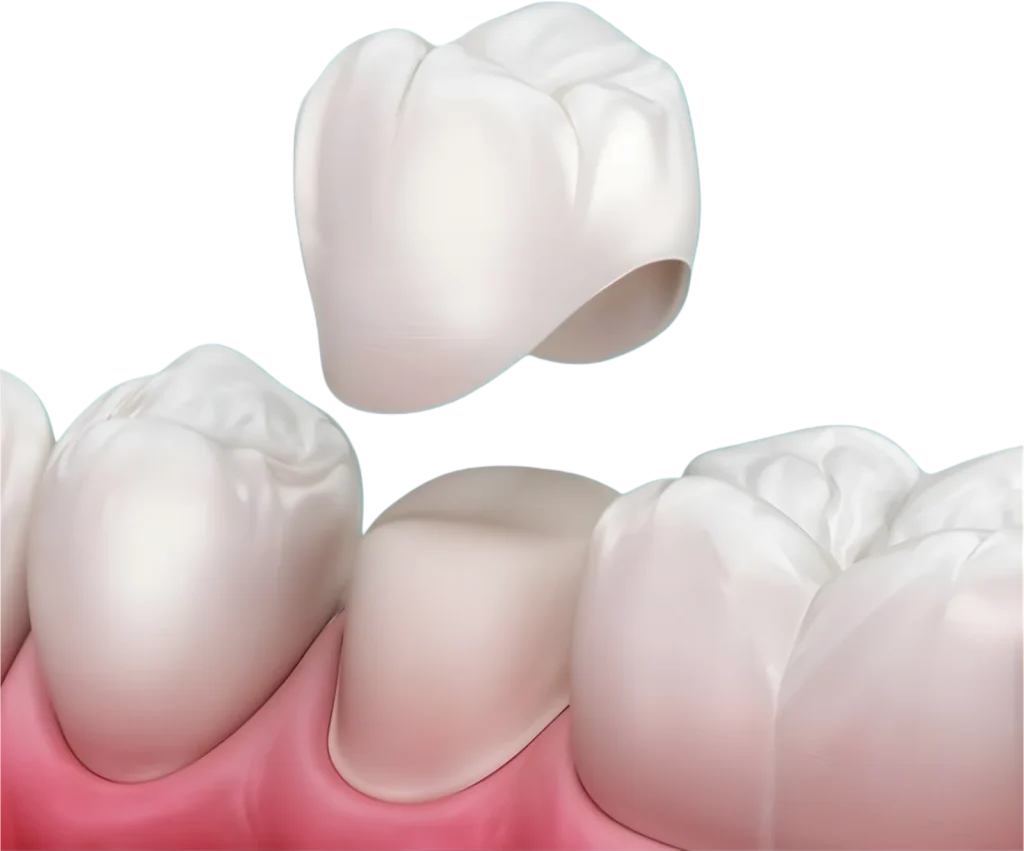
If your dentist has mentioned that you might need a crown or a bridge — or you’ve been researching your options after losing or damaging a tooth — it’s easy to feel uncertain about what each one actually does and which one applies to your situation.
The two treatments are related but serve different purposes. A crown restores a tooth that’s still in your mouth. A bridge replaces a tooth that isn’t there anymore. Understanding that distinction is the starting point for everything else in this guide.
What Is a Dental Crown?
A dental crown is a custom-made ceramic cap that fits over a tooth that is still present but has been damaged, weakened, or significantly decayed. Think of it as a protective shell that covers the entire visible portion of the tooth above the gumline, reinforcing it and restoring its original shape, size, and function.
Crowns are typically recommended when a tooth has undergone root canal treatment and needs protecting, when a large filling has left the tooth structurally vulnerable, or when a crack or fracture threatens its long-term stability. In some cases they are also used for cosmetic reasons — for example, to improve the shape or symmetry of a tooth that has always been irregular.
The crown doesn’t replace the tooth. It works with the tooth that’s already there, preserving it for the long term.
What Is a Dental Bridge?
A dental bridge is a fixed prosthetic that fills the gap left by a missing tooth — one that has been extracted or lost entirely. It does this by suspending an artificial tooth (called a pontic) between two crowns, which are fitted over the natural teeth on either side of the gap. Those neighbouring teeth act as anchors, holding the bridge securely in place.
Once fitted, a bridge is permanently fixed and functions like natural teeth. You eat, speak, and clean around it in largely the same way you would your own dentition, though flossing requires a little more attention around and beneath the bridge.
The key thing to understand about a traditional bridge is that it requires the two abutment teeth on either side to be prepared — meaning some of their natural structure is removed to accommodate the crowns. This is worth weighing up as part of the decision, particularly if those neighbouring teeth are otherwise healthy.
At SnapFit Denture Practice, implant-supported bridges are also available for patients who prefer not to alter healthy adjacent teeth — more on that distinction below.
Crown vs Bridge: The Key Differences Side by Side
The most important distinction between the two is what problem each one is solving. A crown is the right answer when the tooth itself is still present but compromised. A bridge is the right answer when the tooth is missing altogether and the gap needs to be filled.
Beyond that core difference, there are a few other practical distinctions worth understanding. A crown involves one tooth; a bridge spans a gap and involves at least three units — two crowns and a pontic. Crowns can be used as standalone restorations, or they can serve as the anchoring components of a bridge, which is why the two treatments are so often discussed together.
In terms of longevity, both are durable restorations. Dental crowns at SnapFit Denture Practice typically last 10 to 15 years or more with good oral hygiene and regular check-ups, though this varies depending on where in the mouth the crown is positioned and factors like grinding. Bridges have a similar lifespan, though they can be more susceptible to issues over time if the abutment teeth develop problems beneath the crowns or if gum recession occurs around the supporting teeth.
When Would You Need Both?
It’s worth knowing that a bridge is essentially built from crowns — the anchoring components on either side of the gap are crowns fitted over the abutment teeth. So if you need a bridge, you also need crowns as part of that same procedure. They are not mutually exclusive treatments; one contains the other.
Where you might need a crown independently of a bridge is in situations where no tooth is missing — just damaged. And where you might have crowns placed alongside a bridge but for different reasons is in more complex cases where multiple teeth in different areas of the mouth need attention simultaneously.
What About Implant-Supported Bridges?
A traditional bridge relies on the teeth on either side of the gap as anchors. An implant-supported bridge, by contrast, is anchored to dental implants placed in the jawbone rather than to natural teeth. This approach has two significant advantages: it doesn’t require altering healthy neighbouring teeth, and the implants stimulate the jawbone, helping to prevent the bone loss that occurs when a tooth root is absent.
At SnapFit Denture Practice, both traditional and implant-supported bridges are available. Which is more appropriate depends on the location and size of the gap, the condition of adjacent teeth, your bone density, and your overall treatment goals — all of which are assessed at your consultation.
How Long Do Dental Crowns and Bridges Last?
With proper care, dental crowns typically last between 10 and 15 years, and in many cases considerably longer. The lifespan depends on the material used, where in the mouth the crown is positioned — back teeth bear more chewing force — and lifestyle factors such as whether you grind your teeth at night. Bridges have a broadly similar lifespan, though the health of the abutment teeth and surrounding gum tissue plays an important role in how well they hold up over time.
The best way to extend the life of either restoration is straightforward: brush and floss thoroughly, attend regular check-ups so any early signs of wear or gum recession can be caught and addressed, and avoid habits that put unnecessary stress on the teeth such as chewing ice or using teeth to open packaging.
Which One Do You Actually Need?
The honest answer is that this is a clinical decision that can only be made properly after a thorough examination. The determining factors — whether the tooth is present or absent, the condition of surrounding teeth, bone levels, bite, and overall oral health — are things that need to be assessed in person.
What this guide can do is give you enough understanding to walk into that appointment with the right questions. If your tooth is still there but damaged, ask about a crown. If the tooth is gone, ask about a bridge and whether an implant-supported option is suitable for you. If healthy teeth would need to be prepared to anchor a traditional bridge, it’s reasonable to ask whether implants might be a better long-term alternative.
Dental Crowns and Bridges at SnapFit Denture Practice, Wolverhampton
John Kooli has 21 years of experience in dentistry with a specialism in prosthodontics — the field that covers crowns, bridges, dentures, and implants. At SnapFit Denture Practice in Wolverhampton, both treatments are delivered with the same precision and attention to detail applied across all our restorative work.
We see patients from across the West Midlands including Dudley, Walsall, and Telford. John Kooli is GDC registered (No. 140799), verifiable on the GDC public register.
If you’re unsure whether you need a crown, a bridge, or something else entirely, a consultation is the right starting point. We’ll examine your teeth, explain your options clearly, and give you an honest recommendation — with no pressure and no unnecessary treatment.
Book your consultation at SnapFit Denture Practice today.