
Dental Implants vs Dentures: Which Is Right for You?
If you’re missing one or more teeth, two of the most common solutions you’ll come across are dental implants and dentures. Both restore your smile and help you eat and speak more comfortably — but they work very differently, suit different patients, and come at different price points.
This guide breaks down the honest differences between the two so you can walk into your consultation at SnapFit Denture Practice knowing exactly what questions to ask.
What Are Dental Implants?
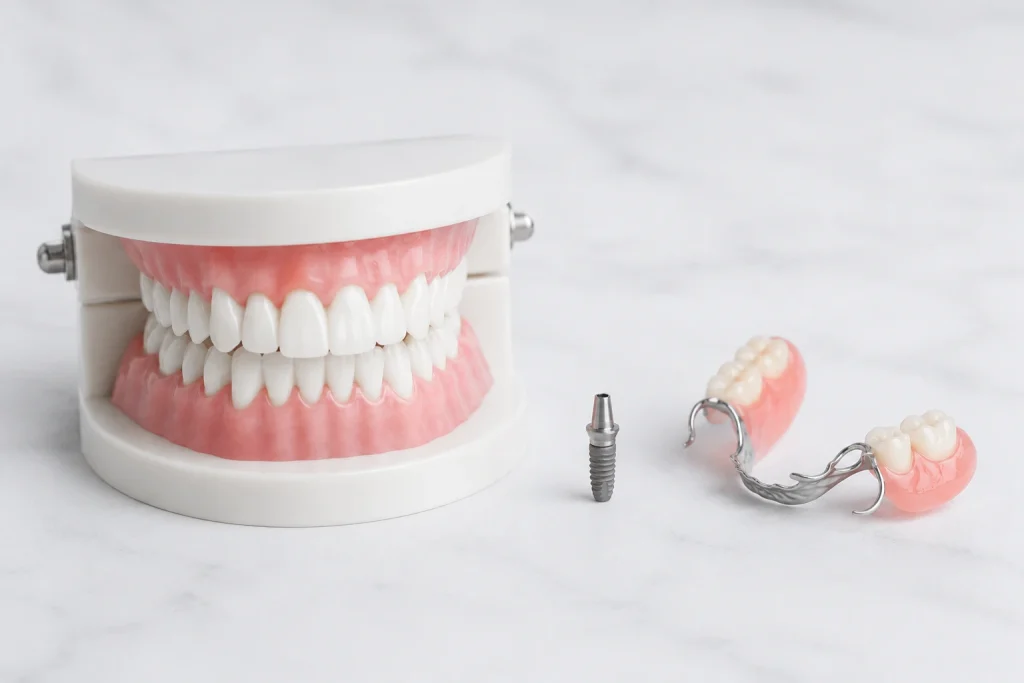
A dental implant is a small titanium post that is surgically placed into your jawbone to replace the root of a missing tooth. Once the implant has fused with the bone — a process called osseointegration that takes several weeks — a custom crown, bridge, or implant-retained denture is attached on top.
The result is a fixed, stable replacement tooth that functions almost identically to a natural one. It doesn’t come out. It doesn’t move. And because it’s anchored in the jaw, it stimulates the bone and helps prevent the facial sagging that can occur after tooth loss.
What Are Dentures?
Dentures are removable prosthetic teeth designed to replace multiple missing teeth — or a full arch. They sit on the gums and are held in place either by natural suction, dental adhesive, or in the case of implant-retained dentures, by snapping onto implants placed in the jaw.
Modern dentures are far more comfortable and natural-looking than the versions people associate with older generations. At SnapFit Denture Practice, all dentures are made in our on-site lab, which means a better fit and faster turnaround than practices that outsource to external labs.
Dental Implants vs Dentures: The Key Differences
Stability and Comfort
Dental implants are the most stable tooth replacement option available. Because they are fixed into the jawbone, there is no movement, no slippage, and no need for adhesive. Most patients forget they’re even there.
Conventional dentures, by contrast, sit on top of the gums and can shift slightly during eating or speaking, particularly as the gum and bone shape changes over time. Implant-retained dentures — like SnapFit dentures — sit between the two options, offering significantly more stability than conventional dentures by snapping onto implants for a secure anchor.
Bone Preservation
One of the most clinically significant advantages of implants is that they preserve the jawbone. When a tooth is lost, the bone that used to surround it begins to resorb — shrinking gradually over time. This is what causes the sunken facial appearance that some long-term denture wearers experience.
Implants replicate the stimulation of a natural tooth root, preventing that bone loss from occurring. Conventional dentures do not provide this stimulation, so bone loss continues underneath them. Implant-retained dentures offer partial benefit here, depending on the number of implants used.
Treatment Timeline
Implants require surgery and a healing period of several weeks before the final restoration can be fitted. The full process from consultation to completed treatment typically takes several months. This is worth understanding upfront — implants are not a quick fix.
Dentures can be made and fitted far more quickly, particularly at SnapFit where the lab is on-site. For patients who need teeth replaced without a lengthy treatment timeline, dentures are often the more practical starting point.
Cost
Dental implants are a more significant financial investment than dentures. A single implant in the UK can range from around £1,500 to £3,000 or more depending on the complexity and the clinic. Full-arch implant solutions are considerably more.
Dentures are more accessible at a range of price points. At SnapFit Denture Practice, partial dentures start from £450 for a single tooth replacement, making them a practical option for patients who need to restore their smile without the cost of implants.
Suitability
Not everyone is immediately suitable for implants. Adequate bone density is required for the implant to integrate successfully — patients with significant bone loss may need a bone graft first, which adds time and cost to the process. Gum health and overall medical history are also considered.
Dentures are suitable for a wider range of patients and can often be fitted sooner, including patients who have recently had extractions or those who aren’t candidates for surgery.
Which Is Better — Implants or Dentures?
There is no single right answer, and any clinician who tells you otherwise without examining you first isn’t giving you proper advice. The right choice depends on your individual circumstances — how many teeth you’re missing, the state of your jawbone, your budget, your timeline, and your long-term goals.
That said, here is a practical framework:
Implants tend to be the better long-term investment if you are missing one or a small number of teeth, have adequate bone, and want a fixed permanent solution that requires minimal daily maintenance. The higher upfront cost is offset by the durability and bone-preservation benefits over time.
Dentures tend to be the better starting point if you are missing multiple teeth across a full arch, need a solution quickly, want to keep costs manageable, or are not currently a surgical candidate. Modern dentures — particularly implant-retained options — are significantly more comfortable and functional than most patients expect.
Some patients start with dentures and later transition to implants or implant-retained options as their circumstances allow. This is a perfectly valid pathway and one that John Kooli at SnapFit Denture Practice can help you plan from the outset.
Why Choose SnapFit Denture Practice in Wolverhampton?
John Kooli has 21 years of experience in dentistry with a specialism in prosthodontics — the branch of dentistry covering dentures, implants, crowns, and bridges. Unlike a general dental practice that offers implants and dentures alongside routine check-ups and fillings, SnapFit Denture Practice is a specialist clinic. This is all we do.
Our on-site lab means your dentures are made here in Wolverhampton — not sent away to an external lab — which gives us more control over fit and quality, and means we can make adjustments without delay.
We see patients from across the West Midlands including Dudley, Walsall, and Telford, and we offer finance on selected treatments.
John Kooli is GDC registered (No. 140799), which you can verify on the GDC public register.
Is a Dental Implant or Denture Right for You?
The best way to find out is through a proper clinical assessment. At SnapFit Denture Practice, your consultation will include a full examination of your oral health, a clear explanation of which options suit your situation, and honest guidance on costs and timelines — with no pressure and no jargon.
Book your consultation at SnapFit Denture Practice in Wolverhampton today.
📞 01902 933982