
Types of Dentures Explained: Which Option Suits You?
If you’re starting to research dentures, one of the first things you’ll notice is how many different types there are. Full, partial, immediate, implant-retained, the list goes on, and it’s not always obvious which term applies to your situation. This guide walks through the main types in plain English, so you know what to ask about at your consultation.
Full Dentures
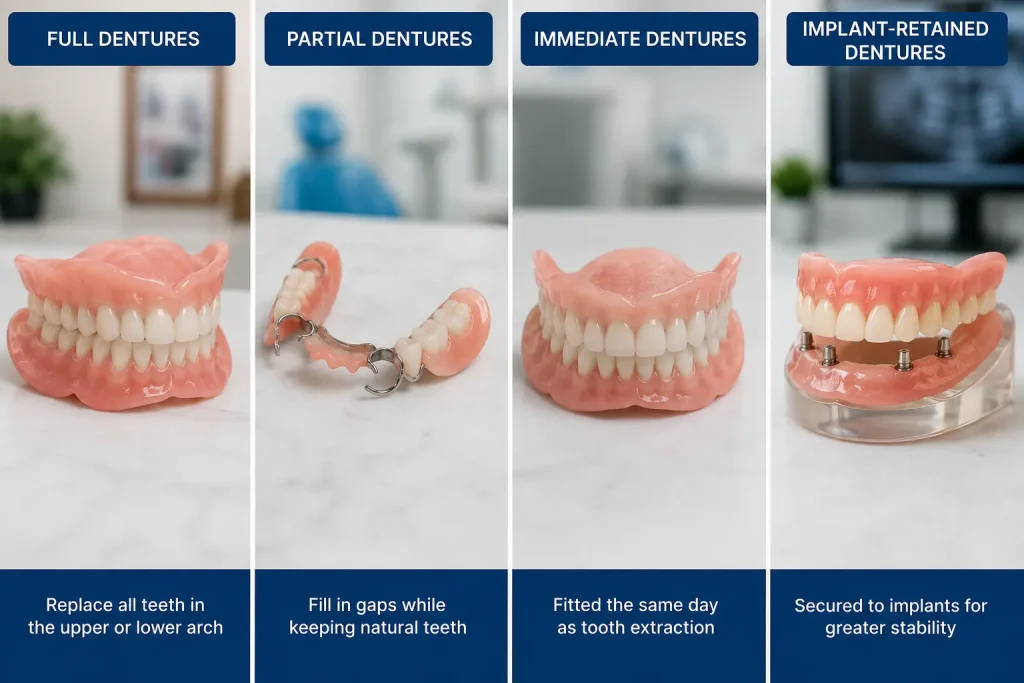
Full dentures, sometimes called complete dentures, replace an entire arch of teeth, either the top, the bottom, or both. They’re used when none of your natural teeth remain in that arch. A full denture sits over the gums and is held in place by suction, natural gum shape, or in the case of implant-retained dentures, by anchoring to implants in the jaw.
Partial Dentures
Partial dentures fill in gaps where some natural teeth are still present. They’re designed to clip or clasp onto the surrounding teeth for extra stability, while replacing the missing ones. This is often a good option for patients who’ve lost a few teeth but want to protect and support the ones they still have. If you’re only missing a single tooth, it’s worth reading our dedicated guide to single tooth dentures, since the considerations are slightly different from a wider partial denture.
Immediate Dentures
An immediate denture is fitted on the same day as a tooth extraction, rather than waiting for the gums to heal first. The advantage is obvious: you’re not without teeth while you heal. The trade-off is that because your gums will change shape as they heal over the following weeks and months, an immediate denture typically needs adjusting, and sometimes replacing, once healing is complete.
Implant-Retained Dentures
Rather than relying purely on suction or gum shape, an implant-retained denture anchors to a small number of dental implants placed in the jawbone. This gives a noticeably more secure fit, particularly for the lower jaw, where conventional dentures can be harder to stabilise. Because the denture still clips on and off for cleaning, it’s different from a fully fixed solution, but the added stability is often the main reason patients choose this route. SnapFit Dentures is our own implant-retained system, designed around a secure, natural-feeling fit.
Removable vs Fixed: An Important Distinction
Most denture types are removable, meaning you take them out to clean them and, usually, overnight. Some implant-supported solutions are designed to be fixed permanently in place and are only removed by a dental professional. It’s worth being clear on which category you’re looking at, since it affects both daily care and the overall treatment approach.
What Are Dentures Made From?
Materials vary depending on the type of denture and what it needs to do:
Acrylic is the most common material for both full and partial dentures. It’s durable, relatively affordable, and can be adjusted or repaired without too much difficulty.
Metal frameworks, often cobalt chrome, are sometimes used for partial dentures because they’re thinner and stronger than acrylic alone, which can make them more comfortable for some patients.
Flexible materials, such as thermoplastic, are used in some partial dentures for a more lightweight, less visible fit. Whether this is the right option depends on your individual case and should be discussed at consultation.
How Do You Know Which Type Is Right for You?
The honest answer is that it depends on a few things: how many teeth you’re missing, the condition of your remaining teeth and gums, your bone density if implants are being considered, and how quickly you need a solution. Same-day dentures may suit patients who want to avoid waiting weeks for a fitting, while others prioritise the added stability of an implant-retained option.
This is exactly what a consultation is for. Rather than guessing which category applies to you, an assessment of your mouth and a conversation about your priorities will point toward the right type.
Getting Started
If you’ve lost teeth and aren’t sure which denture type fits your situation, the clearest next step is a proper assessment. At SnapFit Denture Practice in Wolverhampton, our in-house lab means we can move from consultation to fitting faster than practices that send work to an external lab. Book a consultation and we’ll talk through the options that actually apply to you.