

What Happens If You Don’t Replace Missing Teeth? Effects on Your Jaw, Face & Health
Many adults across the UK are living with one or more missing teeth and doing nothing about it. If the gap is at the back, or not immediately visible when you smile, it can feel like something to deal with later — or not at all. The tooth is gone. The pain has stopped. Life moves on.
But your mouth does not pause while you decide.
From the moment a tooth is lost and not replaced, a chain reaction begins — one that affects your jawbone, your neighbouring teeth, your facial structure, your ability to eat, and your long-term health. The effects are gradual, which is precisely why so many people miss them until they become serious. This article explains exactly what happens, how quickly it happens, and what your options are for stopping it.
Your Jawbone Starts to Shrink — and It Happens Faster Than You Think
When a tooth is missing and not replaced, the jawbone beneath the gap begins to resorb within months. This is the most serious and most overlooked consequence of untreated tooth loss.
Your tooth roots do more than anchor your teeth in place. Every time you bite or chew, the roots transmit mechanical force into the jawbone — and this stimulation signals the body to maintain bone density in that area. Remove the tooth and the stimulation stops. The body, detecting no activity, begins to break down and reabsorb the bone — a process called alveolar bone resorption.
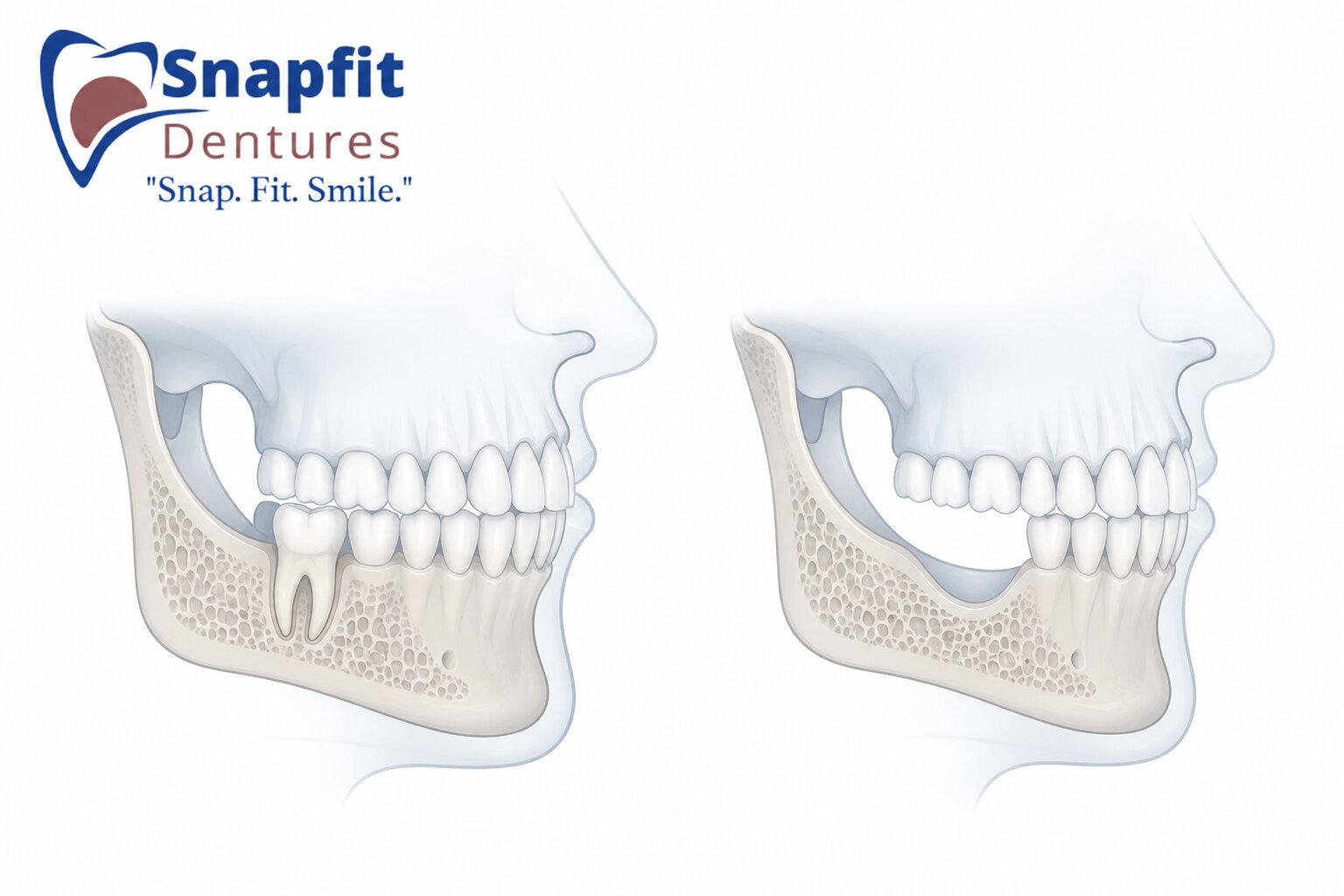
Research consistently shows that patients can lose up to 25% of the bone width in the affected area within the first year of tooth loss alone, and this continues progressively over time. The jaw becomes narrower, shallower, and less structurally sound.
Why does this matter so much? Because bone loss is not just a cosmetic problem. It is a practical one. Dental implants — the most effective long-term tooth replacement option — require sufficient bone volume to anchor into. The longer you leave a gap untreated, the more likely it is that a bone graft will be required before implant treatment can even begin. What could have been a straightforward procedure becomes a multi-stage one. What could have been a manageable cost becomes a significantly higher one.
Bone does not grow back on its own. Acting early preserves your options.
Neighbouring Teeth Don’t Stay Put
Teeth rely on each other for structural support. When one is missing, the teeth on either side begin to lean or drift into the empty space. The tooth directly above or below the gap — with nothing to bite against — begins to over-erupt, gradually moving out of its natural position.
This process is slow and often goes unnoticed until the bite feels off, chewing becomes awkward, or a dentist points it out at a check-up.
The consequences compound quickly. Drifted teeth create tight, irregular gaps that trap food and bacteria — spaces that are difficult to clean properly. This raises the risk of decay and gum disease in teeth that were previously healthy and unaffected. An uneven bite places asymmetric pressure on remaining teeth, accelerating wear and increasing the risk of fractures. In more advanced cases, teeth that have drifted begin to destabilise at the root, becoming loose — triggering further loss.
One missing tooth, left untreated, can eventually lead to the loss of others. It is not dramatic to say so. It is simply what the clinical evidence shows.
If you are weighing up your replacement options, our guide to Snap-In Dentures vs Dental Implants vs Bridges walks through each solution in plain terms.
Your Face Shape Can Change — and You’ll Look Older
This is the consequence patients notice least until it is already well underway — and the one that tends to matter most when they finally do.
Your teeth and jawbone provide the structural scaffolding that supports the lower third of your face. As bone volume decreases beneath a missing tooth, the overlying skin and muscle gradually lose their foundation. The result is a sunken or hollow appearance — particularly around the cheeks, lips, and the corners of the mouth — that produces an aged look that cannot be explained by any anti-ageing product.
Dentists describe this as a loss of vertical dimension: the reduction in the height of the lower face caused by progressive bone and tooth loss. The visible signs include thinning lips, increased wrinkling around the mouth, flattening of the cheeks, and a chin that appears more prominent relative to the nose. These changes can begin with a single missing tooth, particularly in the front or sides of the mouth, and they accelerate significantly when multiple teeth are missing.
It is one of those changes people cannot quite place when they look in the mirror. But it adds up — and it adds years.
The good news is that with the right replacement, particularly implant-supported options, the bone stimulation is restored and further structural deterioration can be halted. In many cases, the support to the surrounding facial tissue is visibly improved.
Chewing, Eating, and Nutrition Are Affected More Than You Realise
Most people who have lived with missing teeth for any length of time adapt their eating habits without consciously realising they have done so. They avoid harder foods. They chew on one side. They take smaller bites. They skip the steak, the raw carrots, the crusty bread.
This adaptation has a real nutritional cost. The foods that become difficult or uncomfortable to eat — fibrous vegetables, lean proteins, certain fruits — are often the most nutritionally dense. Over time, this dietary shift contributes to deficiencies that affect energy, immunity, and general health. For older adults in particular, this is not a minor concern.
There is also a mechanical problem. Chewing consistently on one side of the mouth places uneven pressure on the jaw joint and surrounding musculature. Over time, this asymmetric strain increases the risk of temporomandibular joint (TMJ) disorder — a condition that causes jaw pain, clicking, headaches, and difficulty opening the mouth fully. Patients often do not connect these symptoms to their missing teeth until a dentist asks the right questions.
Restoring proper bite and chewing function has benefits that extend well beyond the mouth.
Speech Can Be Affected Too
Teeth play a direct role in how we form sounds. Front teeth in particular are critical for sounds requiring tooth-to-lip or tooth-to-tongue contact — “f”, “v”, “s”, “th”, and “z” sounds all depend on precise positioning. Missing a front tooth commonly causes lisping or slurring in these sounds. Missing back teeth affects how the tongue moves and positions itself during speech more broadly.
Many patients develop these speech changes so gradually that they stop noticing them. Others become self-conscious in conversation, in meetings, or in social settings — without always being able to name the cause. The effect on confidence is real, even when the change itself seems subtle.
The positive side: speech changes caused by missing teeth are almost always reversible with the right replacement.
The Longer You Wait, the More Complicated (and Costly) Treatment Becomes
There is an understandable tendency to delay dental treatment. It is expensive, it feels non-urgent, and life is busy. But when it comes to missing teeth, delay has a compounding cost that is worth understanding clearly.
Bone resorption is progressive. The window for straightforward implant placement narrows over time. If too much bone has been lost by the time a patient seeks treatment, a bone graft or sinus lift is required before implants can be placed — procedures that add cost, recovery time, surgical complexity, and months to the treatment timeline.
Drifted and over-erupted teeth may require orthodontic correction before a replacement can be fitted accurately. Gum tissue changes as bone recedes, affecting how dentures and bridges sit and feel.
None of this means it is ever too late. At SnapFit Denture Practice, we see patients who have lived with gaps for years, and we are able to help in the vast majority of cases. But we will be honest with you: earlier is always simpler, and simpler is always less costly.
The price of doing nothing now is typically far higher — in money, in time, and in complexity — than the price of acting sooner.
What Are Your Options for Replacing Missing Teeth?
Every patient’s situation is different. The right solution depends on how many teeth are missing, the current state of your jawbone, your budget, and your lifestyle. Here is a plain-English overview of the main options.
Dental implants are the only replacement option that also replaces the tooth root. A titanium post is placed into the jawbone, where it fuses with the bone over time — a process called osseointegration. This restores the stimulation that prevents further bone loss. Implants look, feel, and function like natural teeth and do not rely on neighbouring teeth for support. They are the gold standard for long-term health and are what we recommend wherever bone health and patient suitability allow.
Snap-in dentures (implant-retained dentures) combine the coverage of dentures with the stability of implants. Rather than resting on the gum, they clip securely onto implant fixtures — eliminating the slipping, discomfort, and adhesive pastes associated with traditional dentures. This option is particularly well suited to patients missing multiple teeth who want a fixed, secure solution. It is the approach SnapFit specialises in.
Dental bridges are a fixed option that uses the teeth on either side of the gap as anchors, with an artificial tooth suspended between them. They restore function and appearance without surgery, though they do not prevent bone loss beneath the gap and require the neighbouring teeth to be prepared.
Partial and full dentures are removable and represent a more accessible starting point for many patients. Modern dentures have come a long way — they are more natural-looking, more comfortable, and more precisely fitted than they were a generation ago. They do not stimulate the jawbone, but they restore aesthetics and function and can be a practical solution for the right patient.
One thing that sets SnapFit apart: we have an in-house dental laboratory. That means your dentures are custom-made on site — and in many cases, patients can be fitted within a single day or across just two appointments. There is no outsourcing, no waiting weeks for a laboratory across the country to return your work. It is faster, more precise, and gives us full control over the quality of what you receive.
Ready to Find Out Which Option Is Right for You?
If you are living with missing teeth — whether it has been six months or six years — the most useful thing you can do is have a proper assessment. Not a sales consultation. A clinical one, where someone looks at your bone health, your existing teeth, and your overall situation, and gives you an honest picture of where you are and what your options are.
That is what we do at SnapFit Denture Practice in Wolverhampton.
John Kooli has 21 years of experience in dentistry, with specialist training in prosthodontics — dentures, crowns, bridges, and implants — and an NDip from the Royal College of Surgeons Edinburgh. We are GDC registered and we work with patients at every stage of tooth loss, from those exploring options for the first time to those who have put it off for years and are finally ready to act.
There is no pressure here. Just clear information, honest advice, and treatment that is built around you.
Book your consultation at SnapFit Denture Practice →
You can also visit our Denture Resources section, browse our FAQs, or find out more about us before you get in touch.
Reviewed by: John Kooli, BSc, NDip (Royal College of Surgeons — Edinburgh) | GDC No. 140799 | SnapFit Denture Practice, Wolverhampton