
Denture Repair in Wolverhampton
A broken or cracked denture is never convenient. It usually happens at the worst possible moment, whether that is a chip while eating or a clasp that snaps during cleaning. The good news is that most denture repairs are far quicker and more straightforward than people expect, especially when the practice doing the repair has its own lab on site.
Common Denture Problems That Need Repair
Not every issue with a denture means you need a brand new one. Most problems fall into a few common categories:
- Cracks or breaks – Usually caused by a drop onto a hard surface, or dentures becoming brittle with age
- Loose or bent clasps – Common with partial dentures, where the metal clasp that grips your natural teeth can loosen or bend out of shape over time
- Chipped or worn teeth – The artificial teeth on a denture can chip or wear down, particularly on older dentures
- A denture that no longer fits properly – This is usually a reline rather than a repair, and happens as your gums and jawbone change shape over time
Why You Should Not Try to Fix a Denture Yourself
It can be tempting to reach for superglue when a denture breaks, especially if you need it back in a hurry. This is worth avoiding. Household adhesives are not designed for use in the mouth and can contain chemicals that are unsafe to swallow or absorb through the gum tissue. A DIY repair can also make the eventual professional repair more difficult, since the glue needs to be fully removed before the denture can be fixed properly.
If your denture breaks, the safest option is always to get it looked at by someone qualified, rather than attempt a temporary fix at home.
How Denture Repairs Work at SnapFit
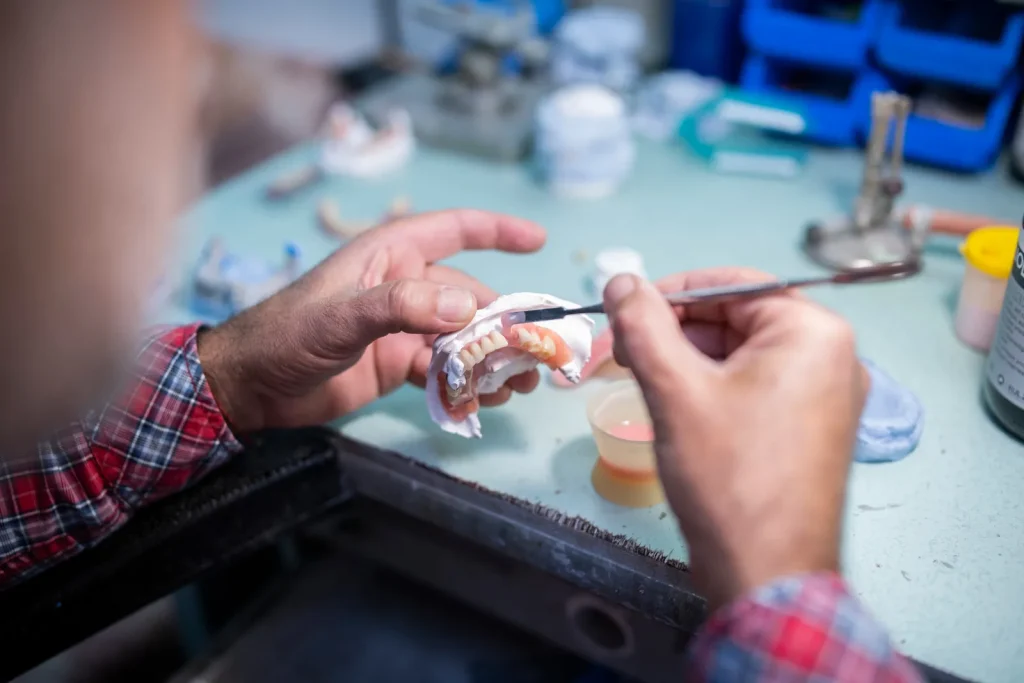
At SnapFit Denture Practice, dentures are made in our on-site lab rather than sent away to an external laboratory. This matters for repairs specifically, because it means adjustments and fixes can often be turned around much faster than practices that rely on outside labs, where a simple repair can take a week or more.
When you bring in a broken or damaged denture, John will assess what is actually wrong. A hairline crack or a loose clasp is usually a straightforward fix. If the damage is more significant, or if the denture no longer fits well because your mouth has changed shape, a reline or a new denture may be the better long-term solution rather than a repeated repair.
When a Repair Is Not Enough
Repairs are a good solution for the occasional accident, but dentures do wear out over time. If you find yourself needing repairs often on the same denture, it is usually a sign that the denture has reached the end of its useful life rather than a sign that something is being repaired badly. You can read more about how long dentures typically last and what affects their lifespan.
If your denture keeps loosening because it relies on your natural teeth for grip, an implant-retained denture is worth discussing, since it removes much of the movement that causes repeated wear and tear in the first place.
Looking After Your Denture Between Repairs
Good day-to-day care reduces how often you will need a repair in the first place. Simple habits like using a proper denture brush instead of toothpaste, avoiding boiling water, and cleaning over a towel or basin of water so a dropped denture has a softer landing all make a real difference. Our full guide to denture care covers this in more detail.
If you wear a partial denture, take extra care not to bend the metal clasps when removing or cleaning it, as this is one of the most common causes of repair callouts.
Get Your Denture Repaired
John Kooli, our lead Clinical Dental Technician, has 21 years of experience working specifically with dentures, crowns, and bridges, and is GDC registered (No. 140799). You can verify this directly on the General Dental Council register.
If you have a broken or damaged denture, get in touch with SnapFit Denture Practice in Wolverhampton and we will let you know the quickest way to get it sorted.