
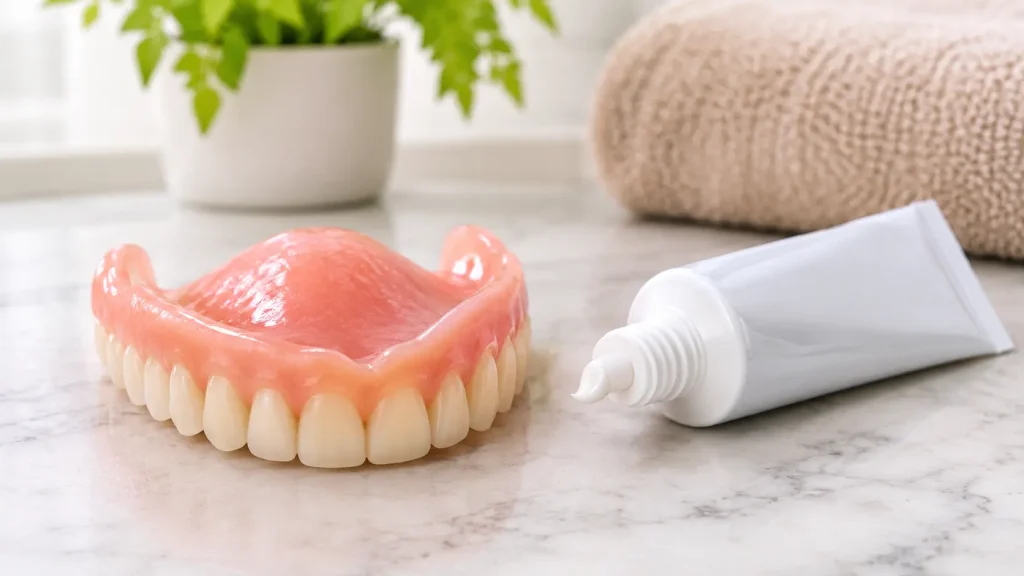
Denture Adhesive Not Working? What to Do Next
If your denture adhesive keeps failing, you are not doing anything wrong by wanting more from it. Adhesive is meant to add a little extra hold to a denture that already fits well. It was never designed to rescue a denture that has stopped fitting.
This guide explains why adhesive stops working, how to use it properly, and what to do when it still will not hold.
Why denture adhesive stops working
Most failures come down to one of a few causes.
The denture no longer fits your gums
This is the most common reason. After teeth are lost, the gum and jawbone slowly change shape. Over months and years, a denture that once fitted well leaves gaps underneath.
Adhesive can only fill a very thin space. If the gap is bigger than that, the adhesive squeezes out, breaks down quickly, and the denture still moves.
You are using too much, or too little
Too much adhesive pushes the denture away from the gum and oozes out at the edges. Too little leaves patches with no hold at all. Small amounts, applied evenly, work better than thick layers.
The denture or your gums are not clean and dry
Adhesive needs a clean, slightly dry surface to grip. Old adhesive left on the denture, food residue, or a very wet gum will all weaken the bond. Our guide to cleaning your dentures properly covers the daily routine that gives adhesive the best start.
A dry mouth
Adhesive needs some saliva to activate. If your mouth is dry, because of medication or a medical condition, adhesive can feel weak or patchy. Mention this to your dentist, as they may be able to suggest options.
Your denture is worn or damaged
Cracks, worn areas, and teeth that have lost their shape can all change how a denture sits. If the denture looks or feels different from how it used to, have it checked. Some problems can be put right with repair work.
How to apply denture adhesive properly
Getting the technique right solves a surprising number of problems.
- Clean the denture and rinse it, then pat the fitting surface dry.
- Rinse your mouth so your gums are clean.
- Apply small dots or thin strips of adhesive to the fitting surface. Keep them away from the very edge.
- Press the denture into place and hold it firmly for a few seconds.
- Bite gently and swallow to settle it.
If adhesive is pushing out at the edges, you have used too much. Next time, use less.
At the end of the day, take your dentures out and remove all the adhesive from the denture and from your gums. Do not sleep in dentures unless a dental professional has told you to.
Does the type of adhesive matter?
Adhesives come as creams, powders, and strips. Some people find one format easier to control than another, and it is reasonable to try a different format if the one you use feels messy.
Some adhesives contain zinc. Overusing these over a long time is not recommended, so follow the instructions on the pack, and check the label if you want a zinc-free option. If you notice numbness, tingling, or any unusual symptoms, stop using the product and speak to your doctor or dentist.
Never use household glue or superglue on dentures or on your gums. These are not safe for use in the mouth.
When adhesive is not the answer
You should see a dental professional if:
- You need more and more adhesive to get through the day
- Your denture moves when you talk or eat even with adhesive
- You have sore spots, redness, or ulcers
- Your face or lips look different because the denture no longer supports them
- Your denture is more than a few years old and has never been checked
Using adhesive to cover a poor fit can hide a problem that is getting worse. A poorly fitting denture can rub the gums and make them sore. Do not wait for it to become painful.
Could a reline fix it?
For many people, yes. A reline adds new material to the fitting surface of your existing denture so it matches the current shape of your gums again. The teeth stay the same, so it is often a simpler fix than making a new denture.
A reline is usually suitable when your denture is in good condition but has become loose because your gums have changed. It may not be suitable if the denture is cracked, badly worn, or the teeth no longer look or bite right. In that case a new denture may be a better option. Our guide on how long dentures last explains when replacement makes sense.
SnapFit has its own dental laboratory on site in Wolverhampton, so changes to a denture can be looked at without sending it away. If you are not sure whether a reline would help, get in touch and we can take a look at your denture.
When dentures keep moving, even after a reline
Some people find that no matter how well a denture is made, it still moves. This is common in the lower jaw, where there is less gum to hold onto, and in people whose jawbone has shrunk a lot over time.
In these cases, a denture that is held by dental implants can give a very different feel. Our page on upgrading loose dentures to snap-in dentures explains how this works. In short, the denture clicks onto implants in the jaw for extra stability, and you can still take it out each day to clean it. You can read more about snap-in dentures and whether they might suit you.
Not everyone is a suitable candidate, as it depends on your jawbone and general health. A dentist will need to assess this first.
What to do next
If your adhesive is not working, the simple steps are:
- Check your technique and use less, not more.
- Clean the denture and your gums properly.
- Have your denture checked, especially if it has been a while.
- Ask whether a reline, repair, or new denture would be the better fix.
- If loose dentures keep affecting your life, ask about implant-supported options.
You should not have to put up with a denture that slips when you eat or talk. There is usually something that can be done.